This module makes possible to calculate the edge effect on the stresses and displacement fields, and more importantly, the effect on the interlaminar stresses in a symmetric elastic laminate (q1,...,qn)S. In this way, the software may help to predict delamination.
The classical laminates theories are not able to evaluate the edge effects. DEILAM calculations are based on the plates model M4-5N (Multiparticular model for Multi-layered Material with 5 kinematic fields per layer for a multi-layered material with N layers). Because of its constitution, this model is richer and more accurate than the classical laminates models. The construction of model M4-5N and its validation may be found in [1,2] . A first version of DEILAM has been already published and validated in [3] ; this first version made possible to evaluate the effects of a free edge on the interfacial stresses. In MAC LAM, the DEILAM version is modified so as to being able to consider any boundary condition at the edges. As we have already said in [1,2,3] , the evaluated interfacial stresses for DEILAM converge quickly and there are no singularities.
For the users interested
in the underlying theory behind DEILAM calculations, we recommend to read the
papers [1,2,3] or the
theoretical outline.
We consider the symmetrical laminate (q1,...,qn)S.
The laminate may be subjected to:
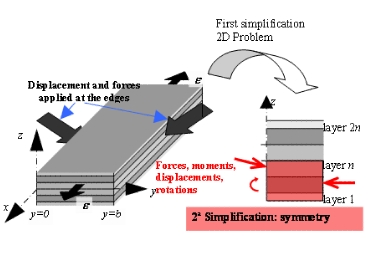
Figure 1. Symmetrical multi-layer and simplification of the problem.
Owing to symmetries, the problem is reduced to the resolution of the problem in the red section in Figure 1. The application of model M4-5N only gives equations in y. These equations are solved with the finite elements method and a meshing of the interval [0, b] . The results of DEILAM are stresses and generalized displacements of the model calculated on the nodes of the mesh.
The following table gives the DEILAM input/output data.
|
Input
data
|
Output
data
|
|
The laminate and its properties The calculation and report options The loads The interval to be meshed |
Membranar forces per layer Shear forces per layer Interfacial stresses Moments per layer Generalized rotations per layer Reports and graphs |
Functioning
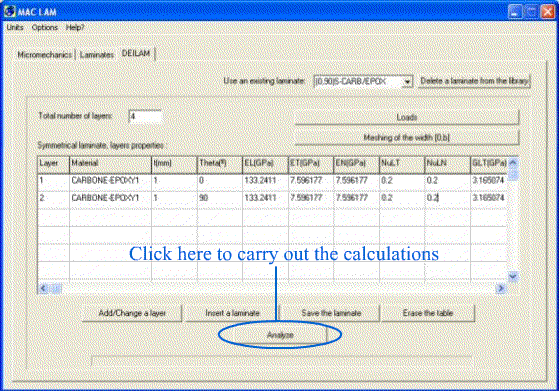
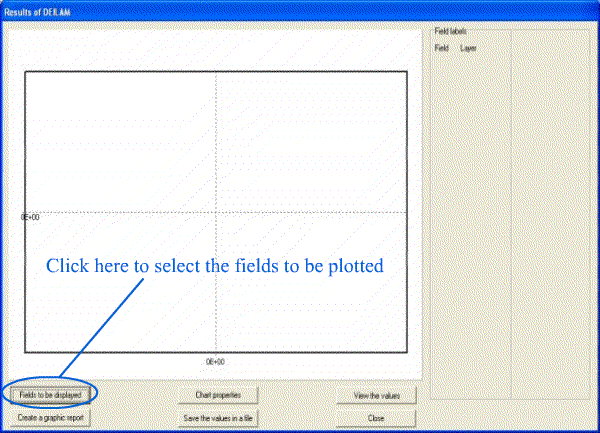
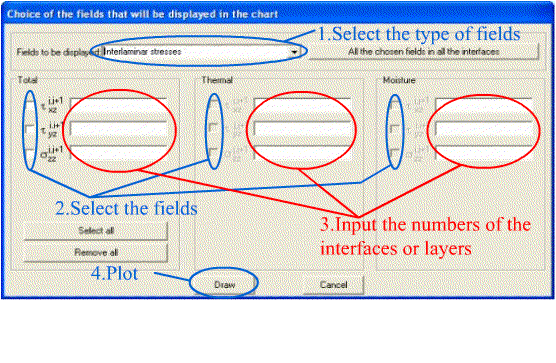
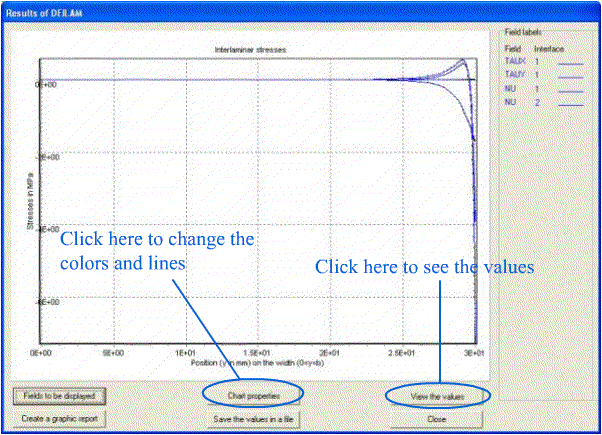
Let's analyze in a detailed way how to work with DEILAM
Figure 2. Launching the DEILAM calculations.
Figure 3. Where to click to select the fields to be plotted?
Figure 4. How to select the fields you want to plot?
Figure 5. Colors, line types and nodal values.
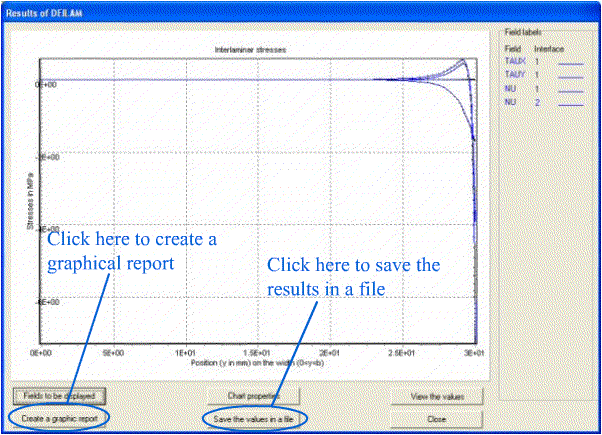
Figure 6. Creating a graphical report and saving the values in a file.
Calculation and report options
Before you launch the calculations in DEILAM, you have to define the Calculation and report options by clicking on "Options" in the menu bar in the main window (see Figure 7).
Figure 7. Where to click in order to define the DEILAM Calculation and report options?
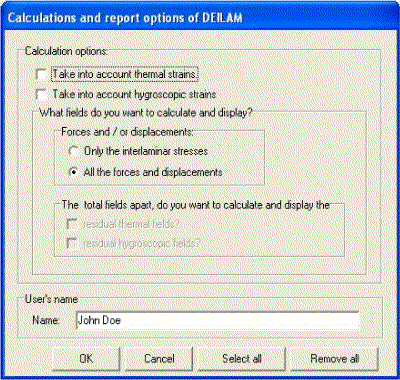
Now, you will see the window in Figure 8. There you have to select the Calculation and report options. Among the options you will find
Figure 8. Calculation and report options in DEILAM.
Important remarks
|
In DEILAM, the interfacial shear stresses do not verify the 3D boundary condition: tyz = 0 In order to verify these conditions, we should enrich the M4-5N model. Nevertheless, even if this condition is not satisfied, the M4-5N makes an accurate evaluation of these interfacial stress along the width [0,b][1,3]. The 3D finite elements near the edges and near the interfaces between two different materials provide mesh-dependent results (singularities exist). DEILAM provide finite values at the interfaces and at the edges and results converge quickly. For some composite laminates, these values proved to be able to predict accurately delamination on set [1,2,3] |
References
[1] CARREIRA RP, CARON JF, DIAZ DIAZ A. "Model of multi-layered materials for interface stresses estimation and validation by finite element calculations", Mechanics of Materials, 34, 217-230, 2002.
[2] DIAZ DIAZ A., CARON JF, CARREIRA RP. "Un modèle de stratifiés". Comptes Rendus de l'Académie des Sciences, 329, 873-879 (2001).
[3] DIAZ
DIAZ A., CARON JF, CARREIRA RP, "Software application for evaluating interfacial
stresses in inelastic symmetrical laminates with free edges", Journal of
Composite Structures, 58, 195-208, 2002